

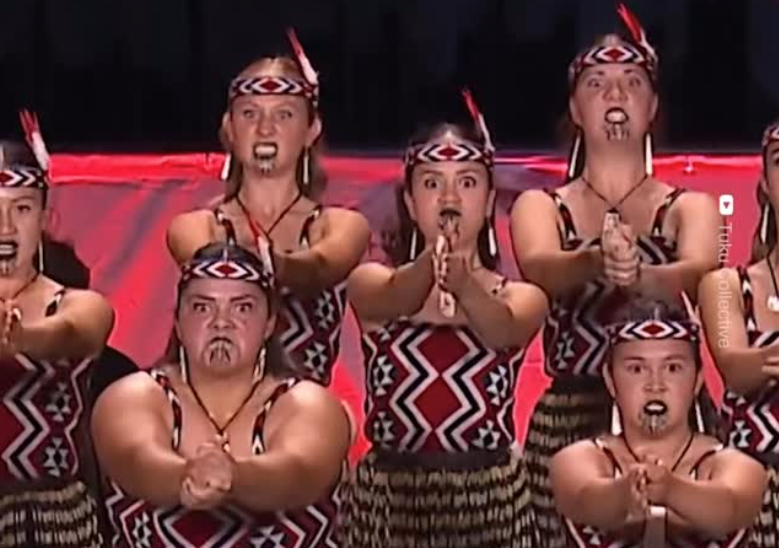
I found them mid-scroll — women claiming their space at a national competition with a performance so earth-shatteringly powerful that I found myself crying into my salad. The video appeared in my feed in the middle of the day on a Tuesday, the kind of lunch scroll that usually yields nothing more than skincare ads.
But this? This stopped everything.
These were the ugly kind of tears that come from somewhere primal, the kind that signal your soul recognizing something it didn’t know it was missing. Because watching these women — backs straight, voices thundering, eyes blazing with the kind of fire we’re taught to dim — felt like witnessing a revolution in real time.
Experiencing Haka (even in a video) was a new thing to me. I never heard of it, never seen it, but when I saw women dressed in warrior costumes on my screen I had a click. I was intrigued, curious — and I’m glad I was, because now I want to bring Haka to the world.
(View this post on Instagram — @femalequotient)
Haka Beyond the Rugby Field
Haka isn’t a masculine tradition that women have crashed. This ancient Māori practice has always included women, though colonial misunderstanding buried that truth for decades. Haka is spiritual technology — a full-body expression designed to channel ancestral energy, tell stories, and connect performers to something larger than themselves.
The movements, the chants, the fierce facial expressions (yes, including those magnificent tongue extensions) aren’t meant to intimidate. They’re meant to embody truth. Raw, unfiltered, unapologetically authentic truth.
In Māori culture, the roles of wāhine (women) in haka and poi are deeply rooted in mythology, spiritual practice, and tribal identity. According to Māori tradition, the very first kapa haka group was a gathering of women — atua wāhine (female deities) assembled by Tinirau — establishing women as the original architects of this performance tradition. Poi, a performance art exclusive to New Zealand Māori, was historically used by women to maintain the flexibility and strength of their hands and arms for everyday tasks like weaving, while also serving as a musical form performed alongside waiata (songs).
While certain war-form haka were traditionally led by men, women have always held integral roles in kapa haka — leading poi, waiata ā-ringa (action songs), and the sacred karanga (the first ceremonial call of welcome), which is exclusively a woman’s domain. The contemporary national competition Te Matatini formally recognises the manukura wahine (female leader) as a distinct and celebrated role, affirming that Māori women’s contribution to performance is not peripheral but foundational.
For too long, we’ve seen sanitized versions — rugby teams psyching up crowds, tourist performances stripped of their spiritual core. But women’s haka teams worldwide are reclaiming the practice’s full power, and in doing so, they’re redefining what feminine strength looks like when it’s not filtered through centuries of “be palatable, be nice, be small.”
The Performance of Acceptable Femininity
Here’s the uncomfortable truth we need to address: Western culture has trained us to perform a version of femininity that requires constant self-editing. We’re taught to be assertive, but never aggressive — confident, but never arrogant — powerful, but always likeable — leaders, but still nurturing.
It’s exhausting performance art, this constant modulation of our natural intensity to fit other people’s comfort levels. We’ve become experts at reading rooms and adjusting accordingly — dimming here, softening there, apologizing for taking up space we rightfully own.
Haka obliterates this paradigm entirely. There’s nothing palatable about a woman in warrior stance, feet planted like she owns the earth beneath them, voice carrying the weight of ancestors, eyes locked on yours without flinching. It’s femininity without the filter, power without the performance.
What Ancient Warriors Know About Modern Power
The women I watched weren’t performing strength — they were embodying it. Each stomp claimed ground. Each chant moved mountains. Every gesture screamed: “I am here. I am powerful. I will not shrink.”
This isn’t about cultural appropriation; it’s about witnessing a tradition that honors the full spectrum of feminine power and asking ourselves: what would our lives look like if we stopped performing weakness?
This isn’t a relic. It’s happening right now.
In November 2024, Hana-Rāwhiti Maipi-Clarke — the youngest Member of Parliament in New Zealand’s history — stood up in the middle of a parliamentary session, tore up the Treaty Principles Bill, and broke into haka. She was 21 years old. The chamber erupted. The world watched. She was suspended for seven days. TIME Magazine named her one of the most influential people of the year. She didn’t negotiate her right to take up space. She claimed it — with her body, her voice, and 800 years of ancestral memory behind her.
Then there’s Portia Woodman-Wickliffe, who has led the New Zealand Black Ferns — the women’s national rugby team — in haka on the world stage at the Rugby World Cup. Standing before opponents and global audiences alike, she doesn’t ask for permission to be powerful. The haka she leads isn’t a pre-game ritual. It’s a declaration. We are here. We have always been here. The men’s haka gets the headlines. The women’s haka carries the same fire — and is finally being seen for it.
And behind the scenes, shaping the cultural framework that makes all of this possible, is Dame Hinewehi Mohi — musician, cultural ambassador for HAKA, and fierce advocate for Māori women’s healing and sovereignty. She’s spent decades proving that kapa haka isn’t just performance — it’s medicine, identity, and resistance, all at once.
These women aren’t performing strength for an audience. They’re not softening it for a boardroom or shrinking it to be palatable. They are the living proof that the tradition hasn’t faded — it’s louder than ever.
Imagine bringing that energy — not the literal movements, but the spiritual stance — into your next salary negotiation. Picture standing in your full power during a difficult conversation, speaking with the voice of every woman who came before you. Envision raising daughters who never learn to make themselves smaller in the first place.
The Warrior We’ve Always Been
As I write this, that video still plays in my mind. Those women reminded me of something we’ve collectively forgotten: we are descended from survivors. Women who fought battles, built communities, raised families, and passed down their strength through bloodlines and stories.
That warrior energy is our birthright. We’ve just been taught to bury it so deep that witnessing it in action brings us to tears.
The invitation is clear: stop waiting for permission to be powerful. Stop shrinking to fit spaces that were never designed to hold your full magnificence. Stop performing the kind of femininity that makes everyone else comfortable while leaving you feeling hollow.
The warrior isn’t something you need to find or develop or earn. She’s already there, has always been there, waiting for you to remember. And she’s ready to shake the ground beneath your feet.
Resources
Cultural Institutions & Encyclopedias
- Kapa Haka — Te Ara Encyclopedia of New Zealand
- Te mana o te wāhine – Māori Women — Te Ara Encyclopedia of New Zealand
- Haka and Poi Competitions, Shannon — Te Papa Collections Online
- Poi Awe — Tales from Te Papa, Episode 16 (YouTube)
Government & Academic Reports
- Ngā Hua a Tāne Rore: Benefits of Kapa Haka (2014) — Manatū Taonga / Ministry for Culture and Heritage (PDF)
- Stories of Haka and Women’s Rugby in Aotearoa New Zealand — Taylor & Francis / Journal of Sport History
- The Political Legacy of Māori Women and Beyond — BYU Scholars Archive (PDF)
- Indigenous-based Inclusive Pedagogy: The Art of Kapa Haka — ResearchGate
News & Media
- Hana-Rāwhiti Maipi-Clarke — Wikipedia
- New Zealand Lawmakers Suspended for Māori Haka Protest — AP News
- New Zealand Reckons with Its Own Divisive Culture War — Washington Post
- Dame Hinewehi Mohi — Wikipedia
- Portia Woodman-Wickliffe — Wikipedia
- Black Ferns Haka — New Zealand v Japan, Rugby World Cup 2025 (YouTube)
- Te Matatini — Wikipedia
- Winners Crowned at Te Matatini 2025 — The Guardian

Comments are closed